Trades in Demand in Melbourne. What Employers Need to Know
If you are trying to hire a skilled tradesperson or qualified manufacturing operator in Melbourne right now, you already know how tight it is. Roles that might have filled in two weeks a few years ago are now sitting open for six, eight, sometimes ten weeks. Applications are coming in, but the right ones are…

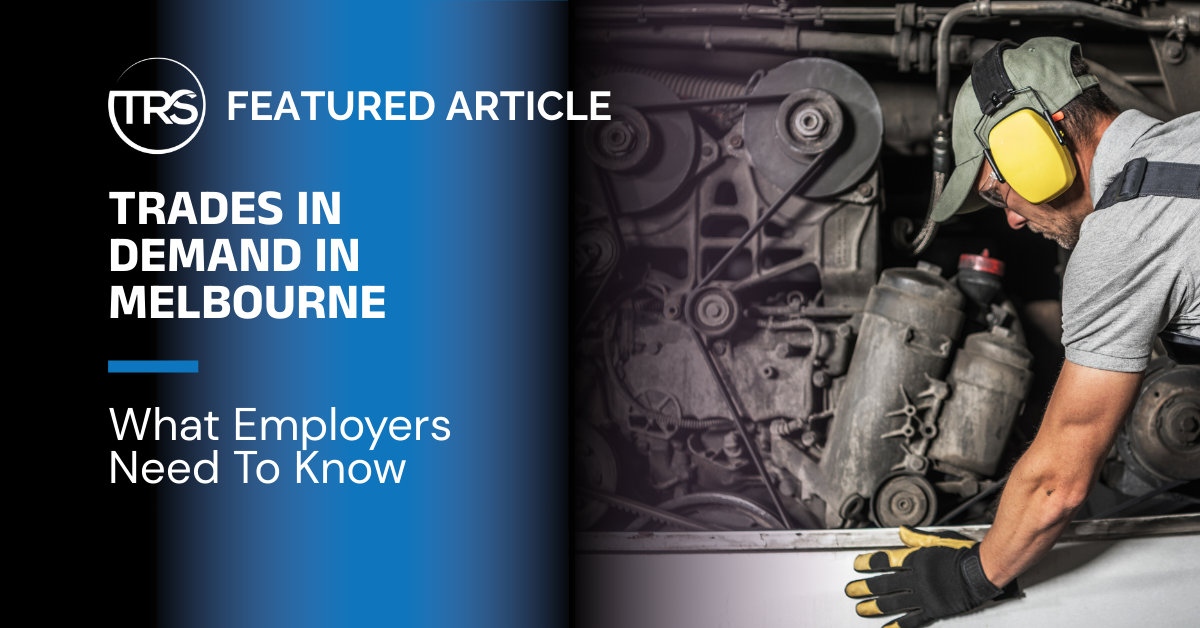
If you are trying to hire a skilled tradesperson or qualified manufacturing operator in Melbourne right now, you already know how tight it is. Roles that might have filled in two weeks a few years ago are now sitting open for six, eight, sometimes ten weeks. Applications are coming in, but the right ones are not. And when a strong candidate does appear, they often have two or three other options on the table.
Understanding which trades are in shortage and why is the first step. Knowing what to do about it is where hiring outcomes are actually won or lost.
Which Trades Are Hardest to Fill in Melbourne Right Now
Across our trades and services recruitment work in Melbourne and Sydney, the roles generating the longest lead times in 2026 are consistent. Boilermakers and fabricators remain in short supply, particularly those with structural or pressure vessel experience. Diesel mechanics and heavy vehicle technicians are extremely difficult to source, with demand outpacing supply significantly across both metro and regional areas. Industrial spray painters, mechanical fitters, and hydraulic technicians are similarly constrained.
Demand for experienced welders has not eased. If anything, the combination of infrastructure investment, manufacturing expansion, and an ageing trade workforce has made the shortage more persistent than it was two years ago.
Electricians and maintenance technicians with automation or PLC exposure are also among the hardest roles to fill, particularly as Melbourne’s manufacturing sector moves toward smarter, more connected production environments.
What Is Driving the Shortage in Manufacturing
In manufacturing recruitment, the story in 2026 is less about overall headcount and more about capability. Businesses can often find people. What they cannot find as easily are people with the right tickets, relevant site experience, and the practical skills to contribute quickly.
The structural nature of this problem is important to understand. Australia has not produced enough trade apprentices across the past decade to keep pace with workforce retirements, population growth, and the expansion of manufacturing and infrastructure activity. Migration has added numbers at the entry level, but it has not filled gaps in licensed, experienced, and supervisory roles.
For Melbourne employers, this means the pool of immediately deployable, fully qualified tradespeople is smaller than it looks. Applicant volume has increased, but applicant suitability has not kept pace. Screening takes longer. Onboarding takes longer. And the risk of a poor hire, in terms of time lost and cost, is higher than it was.
What Employers Can Do Differently in 2026
Plan Earlier Than Feels Necessary
The single most consistent difference between businesses that hire well in 2026 and those that struggle is timing. Employers who start the recruitment process before a role becomes urgent have significantly better outcomes. When a role is genuinely time-critical, the candidate pool narrows and the risk of a compromise hire increases. Building a four to six week runway into your hiring decisions, even for roles you have filled quickly before, is now a practical necessity rather than a preference.
Be Specific About What You Actually Need
Vague job briefs produce vague results. When we receive a clear, specific brief that outlines the exact trade qualification required, the machinery or environment the candidate will be working in, the hours, the team structure, and the realistic career opportunity, we can move faster and more accurately. Businesses that treat the briefing process seriously consistently see stronger shortlists and faster placements.
Over-specifying is also worth watching. If you are asking for fifteen years of experience in a role that realistically requires eight, you are eliminating good candidates before they reach you.
Understand Where Your Candidates Actually Live
Melbourne’s geography matters more than many employers account for. A role in Dandenong South draws from a different candidate pool than a role in Campbellfield or Bayswater. Workers are making decisions based on commute time and practical proximity, not just pay rate. If your site is in an outer suburb, your recruitment strategy needs to reflect where qualified tradespeople in that corridor are actually living and what it takes to attract them to your business specifically.
Move When You See a Strong Candidate
In the current market, hesitation costs placements. Experienced tradespeople who are actively looking are typically considering more than one opportunity at a time. A two-week gap between interview and offer, without communication, is often enough to lose a candidate entirely. Businesses that have streamlined their internal approval processes and are prepared to move within two or three business days of a strong interview are consistently outperforming those with longer decision cycles.
Think Beyond the Immediate Vacancy
The businesses we see achieving the most consistent hiring outcomes in trades and manufacturing are not just filling seats. They are thinking about workforce continuity. That means considering temp-to-perm pathways for candidates who need a foot in the door, investing in onboarding that sets people up to succeed, and building a reputation as an employer that experienced tradespeople want to work for. Word travels quickly in trade networks. A strong workplace reputation is a genuine competitive advantage in a tight market.
The TRS Perspective
At TRS Resourcing, we work with Melbourne and Sydney businesses every day across trades, services, and manufacturing. The employers securing consistent results in 2026 are not the ones waiting for the market to ease. They are the ones adjusting how they recruit, when they recruit, and who they partner with to do it.
Trades shortages in Melbourne are not a temporary condition. They are structural, and they require a more deliberate approach than most businesses have historically applied to hiring.
To find out how TRS Resourcing can support your hiring needs, submit a vacancy or get in touch with our team today.
What We’re Seeing in the Trades Market Right Now: A TRS Resourcing Update from the Director
If you have any questions, please get in touch with us via this form
